

Bitcoin has undergone a remarkable evolution. There are many different perspectives about its nature. Others see it as an everyday currency, while others view Bitcoin as the modern equivalent to gold, which is used for storage of value. Still others consider it a global decentralized platform that secures and validates off-chain transaction. Bitcoin has become a base digital money.
It is similar to gold in terms of its physical form. bearer asset, inflation hedge, and providing currency Bitcoin has a fixed supply of 21 million units and a transparent algorithm. It is revolutionizing the idea of currency base assets. A non-discretionary policy is ensured by its transparent algorithm and a fixed supply of only 21 million Bitcoins. In contrast, fiat currency such as the US dollar relies on central authorities to control its supply. This raises questions regarding their predictability, effectiveness, and efficiency in an age marked by volatility, uncertainty and complexity.
It is noteworthy that Nobel Prize winner Friedrich August von Hayek criticized centralized financial decision making in his book “The Pretense of Knowledge.” Bitcoin’s predictable and transparent monetary policies stand in stark contrast with traditional fiat currency management, which is opaque and unpredictable.
Bitcoin: To Leverage or not to Leverage?
The immutable limit of 21,000,000 bitcoins is sacred to Bitcoin supporters. Altering it would fundamentally Bitcoin can be altered to become something else. The Bitcoin community is skeptical of leveraged Bitcoin. Leverage is seen by many as being similar to the fiat currency system, and therefore undermining Bitcoins’ core principles.
The skepticism about leveraging Bitcoin stems from the difference between circulation credit and commodity credit. outlined by Ludwig von Mises. The basis of commodity credit is real savings. Circulation credit, on the other hand, lacks this backing and appears to be unbacked IOUs. The Bitcoiners see leveraging as a way to create “paper Bitcoin‘ as destabilizing and economically dangerous.
Even the nuanced viewpoints within the community remain cautious when it comes to leveraging. They align with individuals like Caitlin long, who have been warning against Leverage Bitcoin is dangerous. Long, along with others, expressed concern about the dangers of using leveraged Bitcoin lenders such as Celsius or BlockFi.
Celsius and Co. Proof of the Point
Crypto lending was affected by a credit crunch similar to that of Lehman Brothers in 2022. Contrary assumptions, many crypto lending activities are not peer to peer and carry significant counterparty risk, since customers lend directly to platforms that then deploy these funds in speculative strategy without adequate risk-management.
The DeFi summer 2020 was marked by the emergence of many major DeFi protocols. These offered new avenues to generate yield. Nevertheless, some of these protocol lacked sustainable Tokenomics and business models. To maintain attractive yields they relied on the inflation of protocol tokens. resulting Unsustainable eco-systems that are disconnected from basic economic principles.
It highlighted concerns over transparency, risk, liquidity, market and counterparty. It also highlighted the dangers of centralized and off-chain processes for risk management, especially when they are applied to blockchain-based “banking services,” The traditional bank mistakes are not to be emulated.
Despite the optimistic outlook for the bull market in 2020/21 many institutions, such as Voyager Capital, Three Arrows Capital Celsius, BlockFi and FTX failed due to the absence of these processes. Due to an inability to carry out checks and balanced independently, transparently, and with transparency often leads to excessive regulation and fraud. The absence of regulations is also not the solution.
It is essential to have a Bitcoin Yield.
What does this mean for us? In light of this episode in 2022, Bitcoiners have begun to ask the following question: Do we need Bitcoin yield products? Or do they represent a greater risk and resemble the features of the fiat currency system, which is reminiscent of Bitcoins’s past history? Although there are valid concerns, it is unrealistic to think that Bitcoin-based products will disappear.
With the new Bitcoin ecosystem, the question becomes more and more prominent. Projects are increasingly building or claiming to be building out the financial infrastructure and applications directly on Bitcoin. Can this cause the same problems as we have seen in the cryptosphere at large?
Yes, most likely. It’s the nature of things. Since Bitcoin is an open protocol, anyone can create on it. This includes those who are interested in building Bitcoin-powered financial services. Finance will need to have credit and leverage.
It is an historical fact that credit and production are essential in any society. arisesCredit is an important catalyst of economic growth. Economies in underdeveloped regions struggle to move beyond subsistence. Credit is essential for a productive and sophisticated economic system.
In order to realize the vision for a Bitcoin economy, supporters recognize the necessity of credit and yield systems that are built on the Bitcoin protocol. Bitcoin is often touted as an alternative currency. However, in order for Bitcoin to be a viable option, it needs to have a number of features. native economy It is important to do so.
It is clear that Bitcoin-based products are essential to the development of an economy centered on Bitcoin. A Bitcoin-based ecosystem could use yield products as a way to increase adoption and utilize Bitcoin.
Anon, it’s all a Trust Spectrum
The Bitcoin-based finance system will be constructed in layers. It’s not that different to today’s current financial system in terms of the inherent hierarchy within money-like asset types. For a better understanding of the inherent trade-offs, it’s important to create a framework that allows you to differentiate between the various implementations and layers.
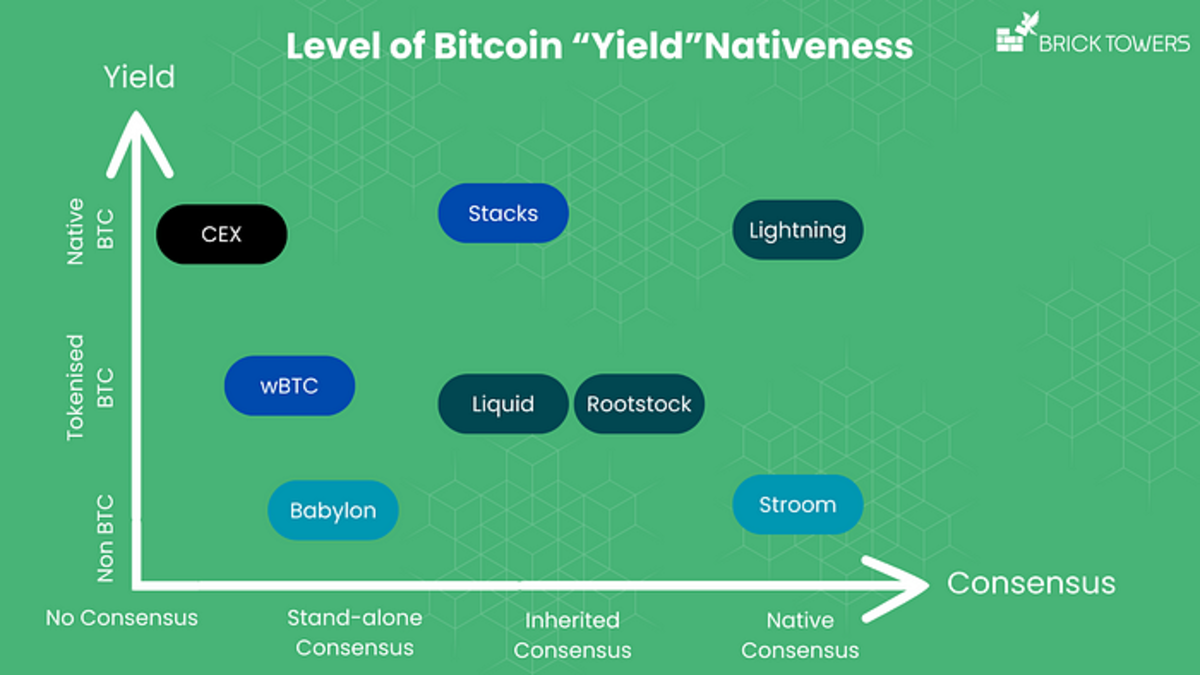
In order to offer yields on Bitcoin it’s important to realize that you can build options along three different trust scales. Primary aspects are:
- Consensus
- Enjoy the Benefits of a Stunning Asset
- Yield
By evaluating Bitcoin-like products and assets based on the degree of Bitcoin nativeness, you can evaluate their alignment to Bitcoin’s values. These assets are more resilient and transparent, and less dependent on third parties.
As reliance shifts away from intermediaries, this reduces counterparty risk. Code transparency is enhanced compared with intermediaries.
It is worth exploring this progression, as creating options to create a native return on Bitcoin would be the ideal and ultimate goal for the Bitcoin community.
Consensus Angle
This classification categorizes Bitcoin-yield products according to their alignment with Bitcoin’s blockchain consensus. It distinguishes between four categories.
- This is a centralized platform where infrastructure remains on-chain. Examples are centralized platforms, such as BlockFi and Celsius, that hold the full custody of users’ funds, making them vulnerable to counterparty risks. These platforms use Bitcoin but their yield strategies are mostly executed through conventional finance methods. Although these platforms represent a significant step toward Bitcoin adoption, they are still highly centralized and resemble traditional financial organizations, but often lack regulation.
- Standalone Consensus : The base infrastructure in this category is decentralized and includes blockchains that are public, such as Ethereum BNB Chain Solana etc. The blockchains in this category have their own independent consensus mechanisms, and they are not directly tied to Bitcoin’s consensus.
- The base infrastructure, which is represented by Layer-2 solutions or Bitcoin sidechains, has a distributed consensus. Although these sidechains are independent of Bitcoin, their goal is to become more similar. These include federated blockchains, such as Rootstock or Liquid Network.
- Native Consensus This category uses Bitcoin’s native security mechanism. This approach uses state channels off the blockchain that are cryptographically tied to Bitcoin’s blockchain, rather than a sidechain. Lightning Network, a great example of such an approach that relies on Bitcoin consensus to minimize trust levels, is the best way of implementing this.
Bitcoin is the closest yield product to Bitcoin. Native consensusThe more closely aligned a currency is to Bitcoin, and the less trust it’s perceived as having. There are nuances within the The following are some examples of how to get started: The inheritance of consensus There are different categories of infrastructure, with varying levels of security and decentralization.
While, no consensus This results in the least amount of centralization and minimal trust. Native consensus The highest degree of trust minimization is achieved by using consensus security, though further study of decentralization needs to be done.
Asset Angle
Three main categories can be identified when analyzing the assets used in Bitcoin yield products.
- Non-BTC (non-Bitcoin): Solutions that do not use BTC are included in this category. This results in low alignment to Bitcoin. Stacking, for example, uses STX as a native coin to create a BTC return.
- Tokenized BTC : In this case, BTC is used as a tokenized asset, which increases alignment to Bitcoin in comparison with non-BTC. Tokenized BTC are available on blockchains such as Ethereum (WBTC), renBTC and tBTC), BNB Chain, Solana, and many others. Tokenized BTC can also be found on Bitcoin sidechains that have inherited consensus mechanisms such as sBTC (sBTC), XBTC (aBTC), L-BTC and RBTC.
- Native BTC: Assets that are directly on the Bitcoin blockchain (BTC), without tokenization, offer the most alignment to Bitcoin. BTC can be used by Babylon and CEX’s Bitcoin stake protocol. Babylon’s Bitcoin Staking Protocol aims to increase Bitcoin security through Proof-of Stake. Stroom Network, for example, uses the Lightning Network in order to allow Liquid Staking. Users can earn Lightning Network revenues by depositing BTC, and minting tokens such as stBTC or bstBTC, which are then used within the DeFi ecosystem.
Yield Angle
The question of Bitcoin aligning also comes up when examining the yield-side of Bitcoin yield products. This leads to the same categorizations that are made for the asset-side: non-BTC, tokenized BTCThen, Native BTC.
- Babylon also offers a non-BTC yield in native assets of Proof-of-Stake Blockchains (PoS). This increases the security of blockchains through Babylon’s staking mechanisms.
- Stroom Network’s tokenized BTC yield is provided in the form lnBTC. Sovryn is a Rootstock-based platform that facilitates Bitcoin borrowing and lending using tokenized BTC. Blockstream Mining Notes (BMN), which are traded on the Liquid Network and offer yields of BTC or LBTC, at maturity, provide qualified investors with access to Bitcoin hashrate via a security token that is EU-compliant in USDT.
- Native BTC Yield Stacks has a number of different options. Some yield applications using sBTC include tokenized BTC as a payment option. Stacks stacking, however, accrues yields in native BTC. Similar to centralized products, yields are delivered by some CEXs in native BTC.
Bitcoin’s gold standard: Native through and through
When imagining the perfect Bitcoin-based product with yield, it would have three characteristics: native Bitcoin consensus, native Bitcoin assets and native Bitcoin yield. A product like this would have a Bitcoin alignment that is near perfect.
These solutions are still in the early stages of development. Brick Towers is one such project that’s in development. They believe that the best Bitcoin-based products are those which incorporate native Bitcoin assets, yield, and consensus. Brick Towers, a company that focuses on Bitcoin for long-term saving solutions, aims to offer customers a native and trust-minimized approach to using Bitcoin.
The solution they have in mind revolves around the generation of a native Bitcoin yield, while leveraging Brick Towers automation services for other Lightning Network nodes. By using an optimization algorithm to maximize economic utility, the capital will be strategically allocated in order to meet other participants’ liquidity requirements.
The Lightning Network is boosted by this approach, which also increases Bitcoin’s value as an investment. Customers can earn a yield from their Bitcoins in a secure and seamless manner. Brick Towers has developed a solution that does not use wrapped coins. This reduces counterparty risk and reinforces their commitment to Bitcoin’s native ecosystem.
The article has been researched by and written Pascal Hügli In collaboration with Brick Towers. Hügli is a dedicated Bitcoin analyst and researcher, deeply immersed in all facets of the Bitcoin ecosystem. He has spent years studying how to build a solid Bitcoin-based system. This original article appeared in a more extensive version here.
The guest blogger is Pascal Hügli. The opinions expressed by the authors are theirs alone and not those of BTC Inc. or Bitcoin Magazine.
“This article is not financial advice.”
“Always do your own research before making any type of investment.”
“DagelijksCrypto is not responsible for any activities you perform outside DagelijksCrypto.”
Source: bitcoinmagazine.com


